Kluge-Ruhe-60Kluge-Ruhe-Logo-only-60
in 
partnership 
with
Papunya-Tula-Artists-60Papunya-Tula-Artists-logo-only-60-v2
This website was developed for the exhibition Irriṯitja Kuwarri Tjungu | Past & Present Together: Fifty Years of Papunya Tula Artists that was on view at the Kluge-Ruhe Aboriginal Art Collection of the University of Virginia from 2021-23 and the Embassy of Australia in Washington, DC in 2024. It was made possible by our creative partnership with Papunya Tula Artists and the generous support of UVA Arts Council. Site design by Urban Fugitive for V21 Artspace.
Go Back

Charlie Wartuma Tjungurrayi

Untitled (probably The Travels of Kutungu)
Before March 1972

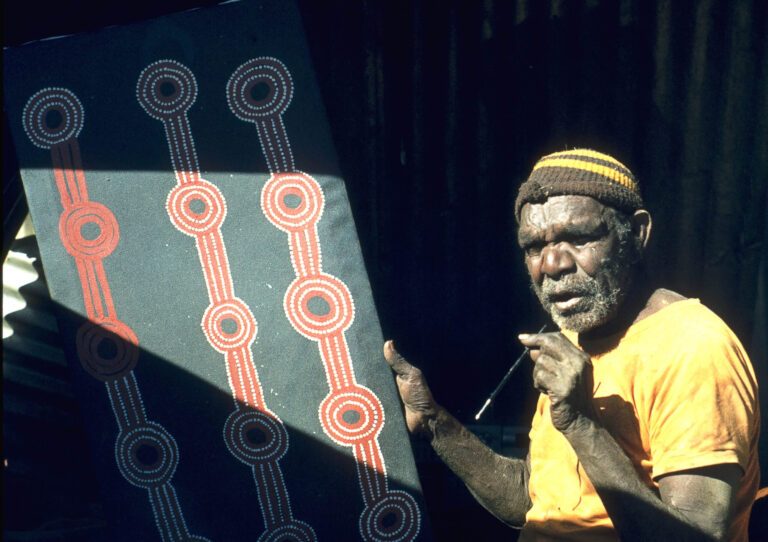
This painting was acquired in 1991 by John W. Kluge with very little information. When it was conserved for this exhibition, the frame was removed, revealing its original stock number. This allowed us to identify it as part of a consignment from March 1972 and attribute it to Charlie Wartuma Tjungurrayi. Further research suggests that it depicts the travels of the ancestral snake woman Kutungu, who is indicated by the solitary footprints and snaking lines. The parallel bars may represent her digging stick.

Kutungu—also known as Walinngi—was an ancestral woman who began her travels from Tjuntu-tjarrpa-nguru ("where the sun goes down"), moving eastward and creating a range of hills south of the Kiwirrkurra road. She hunted, as is common among desert women, with a wana (digging stick) and a piti (coolamon). Her activities left their record on the land at places such as Papunnga, Ngartannga, Yarrannga, Wanatjalnga and, eventually, at Muruntji. Many of the narratives involving Kutungu involve violence and death. At Papunnga, she saw a group of people playing on a sandhill and trapped them in a hole. Fanning a fire (papuntjuninpa means “to fan”), she smoked the hole, putting the people to death. Later, she dug up their bodies and cooked and ate them. According to Yanatjarri No. III Tjakamarra, Kutungu threw away the skinny ones and ate the fat ones. Next, she traveled to Wanatjalnga, where she saw a malpuntarri (quail) nesting on its eggs. After making a wana, she killed the bird, cooked it and ate it along with its eggs.

At Tjintjintjinya, Kutungu made a deep hole, in which she is often depicted transforming into her snake form (see, for instance, Ronnie Tjampitjinpa’s Tjintjintjin from 1990). Near Muruntji, Kutungu fell asleep and was found by a group of boys, one of whom raped her while she slept. When she awoke, Kutungu noticed a smell from her crotch and realized what had happened. She set out for the boys, tracked them, killed them with her digging stick and cooked and ate them. The distinctive rock formations at Muruntji record this event. As she crawled off, toward Kantawanya, she vomited, leaving a mark in the landscape, and transformed into a water snake.

Kutungu had sharp teeth. She was killing all the women and kids and they turned into round, flat puli (stones). She was round Kiwirrkurra, at Yirututu. Because of the many munga (flies) that followed that mamu (devil woman) around, the Wati Kutjarra (ancestral Goanna men) also came through the area. One was a red one, Tinka Tjukurrpa, sand-goanna man. The other was a black one named Puyunynpa Tjukurrpa (a smaller, tree-dwelling goanna). But there were too many flies following them—everywhere, on their shoulders and kuru (in their eyes)—so they ran away and went yungu tjarrpangu (under the ground). That’s why they went into the ground. The Wati Kutjarra used to play jokes and tease Kutungu. At one time, those two Goanna Men climbed up a desert oak that is still there. The put out a maparnpa (a sacred object drawn from their body) and they flew away.

BOBBY WEST TJUPURRULA

Language Group: Pintupi
Dates: 1925-1999

Charlie Wartuma Tjungurrayi was born west of Walungurru (Kintore) at Tjitururrnga in the mid 1920s. He was one of the founding artists at Papunya in 1971 and an original shareholder of Papunya Tula Artists. Charlie’s work most often features stories from around the area of Tjitururrnga and includes Emu, Wallaby, Yam, Water and Frog Dreamings, as well as parts of the Yina Tjukurrpa (Old Man Dreaming) he shared with others. He painted from the beginning of the painting movement in 1971 to his death in July of 1999 and was the first of the founding members to receive his own retrospective. Charlie had nine children with his wife, Tatali Nangala, who also became a recognized painter. Tragically, three of their sons and two of their daughters died before their parents. Charlie’s surviving daughter, Eileen Napaltjarri, is also a painter.

Biographical information sourced from Vivien Johnson, Lives of the Papunya Tula Artists. Alice Springs: IAD Press, 2008.

Are you related to this artist? Are you a scholar of artwork from the Papunya Tula movement? Please contact us at kluge-ruhe@virginia.edu if you would like to add something to this page or see something that is missing or incorrect.
chevron-leftchevron-right